The Gap Between What You Rate and What You Watch
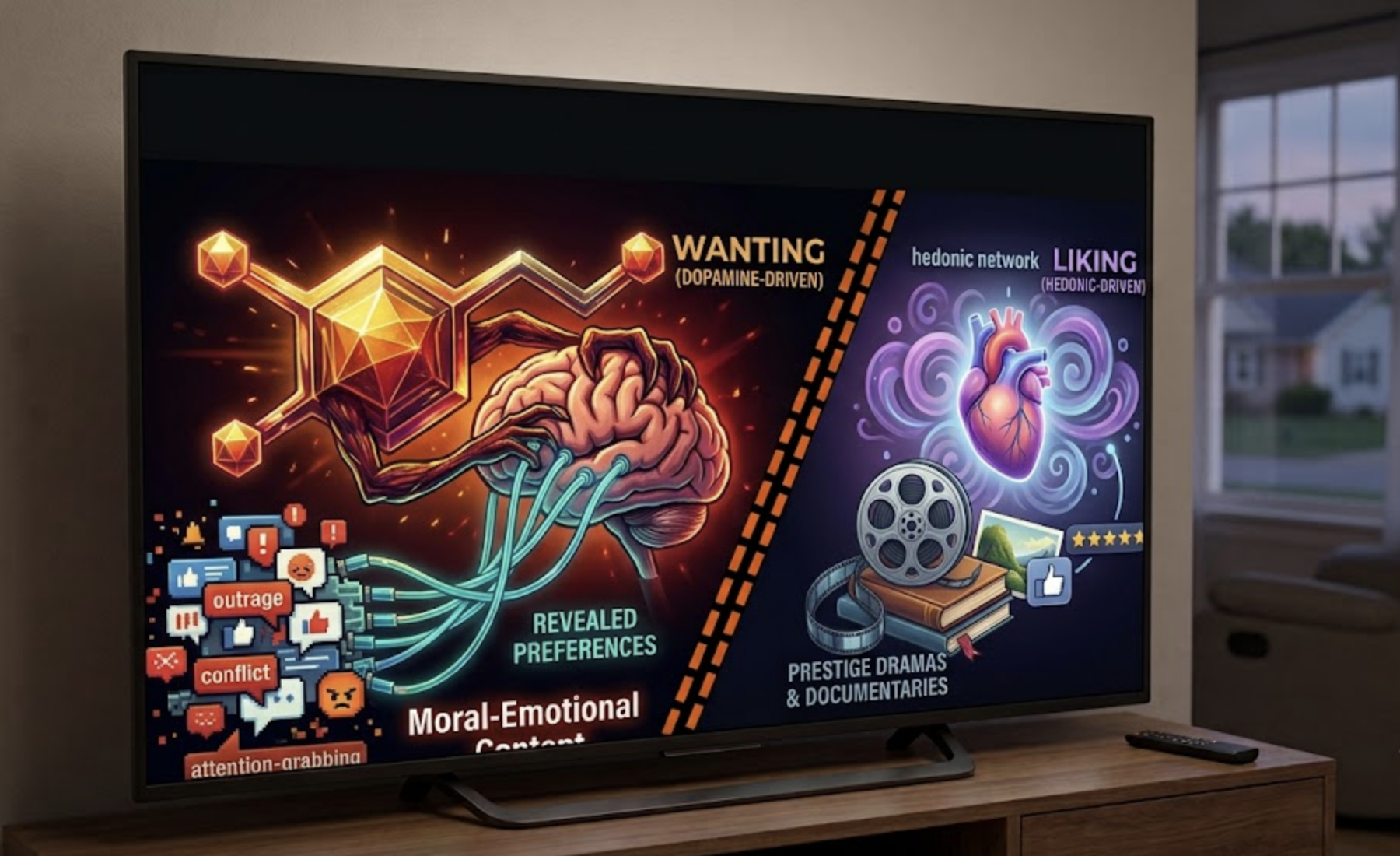
In the early years of Netflix's streaming service, the company built a sophisticated ratings system. Users gave shows one to five stars. The data should have told Netflix what people loved. The problem was that ratings and viewing behavior didn't line up the way you'd expect. People gave five stars to documentaries about climate change and nature films and serious dramas. Then they watched another episode of a reality competition show.
Netflix eventually moved away from star ratings toward a simpler thumbs-up/thumbs-down system — and, more importantly, toward weighting actual viewing behavior far more heavily than expressed ratings. The logic was straightforward: what you watch is a revealed preference; what you rate is a stated preference. And for the purpose of keeping you on the platform, revealed preferences are more useful.
This distinction — between what people say they want and what they demonstrably do — sits at the center of how virtually every major content platform is now built. And once you see it, you can't unsee it.
Wanting and Liking Are Not the Same Thing in Your Brain
The gap between what you click on and what you find valuable isn't just a quirk of human inconsistency. It reflects something real about how the brain's reward system is organized.
In the 1990s, neuroscientist Kent Berridge at the University of Michigan made a discovery that upended a lot of assumptions about motivation. Working with rats and dopamine systems, he found that the brain has two functionally distinct systems for reward: one for wanting something and one for liking it. These systems overlap but are not the same. You can want something intensely and not particularly enjoy it once you have it. You can like something without particularly wanting to seek it out.
Berridge called the wanting system incentive salience — it's driven primarily by dopamine, and it's responsible for directing attention and motivating approach behavior. The liking system is a separate hedonic network, and it operates independently. The practical implication is that dopamine makes things feel urgent and compelling without necessarily making them satisfying. A feed full of content that spikes your wanting system can leave your liking system entirely cold.
This is not just an abstract neurological observation. It has a direct consequence for how recommendation systems shape your experience: a system optimized to maximize what you click on — what you want in Berridge's sense — is not the same as a system optimized for what you'll find valuable or satisfying. The two can diverge significantly, and in the attention economy, they routinely do.
How Platforms Chose Their Metric
In 2012, YouTube made a decision that reshaped online video. Until that point, its recommendation system had been optimized primarily for click-through rate — it surfaced videos that people clicked on. The problem, which YouTube's own engineers recognized, was that this created an incentive to make misleading thumbnails and titles: content that got the click, regardless of whether it delivered on the promise.
The solution seemed reasonable: switch from optimizing for clicks to optimizing for watch time. If people watched a video all the way through, that was a stronger signal that they found it valuable. YouTube announced the change publicly and it was widely praised as a more sophisticated approach to quality.
Guillaume Chaslot, an engineer who worked on YouTube's recommendation system before leaving the company, later documented what actually happened. Watch time, it turned out, had its own distortions. Content that was emotionally activating — outrage-inducing, conspiratorial, increasingly extreme in its framing — tended to produce longer watch times than measured, calm, nuanced content. Users would stay longer not because they were satisfied but because they were agitated, compelled, unable to look away. The recommendation system, optimizing for the signal it could measure, began surfacing more of that content. Not because anyone designed it to radicalize people, but because radicalization is a side effect of optimizing for time-on-screen.
This is not unique to YouTube. Every platform that optimizes for engagement metrics — likes, shares, comments, watch time, re-opens — faces a version of the same problem: the content that drives the most engagement is often not the content people would choose if they were making deliberate decisions about what they actually want to spend their time on.
Why Outrage Travels Faster Than Anything Else
In 2017, William Brady and colleagues at New York University published a study in the Proceedings of the National Academy of Sciences that quantified something many people had suspected but couldn't prove. They analyzed a large dataset of tweets about political topics and found that for every moral-emotional word added to a tweet — words signaling outrage, disgust, contempt, or righteous anger — the retweet rate increased by approximately 20 percent. Calm, reasoned, informational content spread more slowly than content that triggered a moral-emotional reaction.
The finding is important because it clarifies what "engagement" actually selects for at scale. When a recommendation system is trained on engagement signals — shares, likes, comments, re-watches — it is, functionally, being trained on moral-emotional arousal. Content that makes you feel calm and informed scores low on these metrics. Content that makes you feel that something is wrong, that someone should be held accountable, that the situation is outrageous — that content travels.
The platforms didn't design this in. But they didn't design it out either. Internal research at Facebook, revealed through documents provided by whistleblower Frances Haugen in 2021, showed that the company was aware that its engagement-based ranking systems amplified divisive and emotionally activating content — and that removing these effects would meaningfully reduce overall engagement. The company weighed those options and largely kept the systems in place.
The Prediction Problem
There's a deeper issue beneath all of this, which is that humans are genuinely bad at predicting what they'll find satisfying.
Psychologists Timothy Wilson and Daniel Gilbert have spent decades studying what they call affective forecasting — our ability to predict how we'll feel in the future. Their research consistently finds that people systematically misjudge the emotional impact of future events, both positive and negative, and that this extends to media consumption. We overestimate how much we'll enjoy content we seek out, and underestimate how much a different kind of experience would have served us better.
This creates a compounding problem in recommendation systems. The system learns from your past behavior, which was itself shaped by inaccurate predictions. You clicked on the outrage-inducing headline because in the moment it felt important; you watched the inflammatory video because you couldn't look away; you came back to the feed because the variable rewards kept you returning. None of those behaviors reliably reflects what you would choose if asked, after the fact, what kind of media environment you'd like to live in. But they're the only signals the system has. So it builds a model of you from data that systematically misrepresents your actual preferences — and then serves you more of the same.
Why Platforms Don't Fix It
The obvious question is why platforms don't simply optimize for satisfaction instead of engagement. The answer involves both measurement and incentives.
Engagement is easy to measure. A click happens or it doesn't. A video plays for 47 seconds or four minutes. A post gets shared or it doesn't. These are discrete, countable events that happen in real time and can be fed directly into a training signal.
Satisfaction is much harder. It requires asking people how they feel — after an interaction, after a viewing session, after a week of using the product — and those self-reports are slow, inconsistent, and expensive to collect at scale. Some platforms do run satisfaction surveys and incorporate the results into their systems to some degree. But the feedback loop is far slower and noisier than engagement data, which means it carries less weight in practice.
The incentive problem is more fundamental. Engagement, in the attention economy, is revenue. More engagement means more ads seen, more data collected, more platform dependence built. A system optimized for satisfaction might produce users who spend less time on the platform but feel better about it. That trade-off has not been one that publicly traded, advertiser-funded platforms have historically been willing to make — at least not voluntarily.
What This Produces at Scale
The cumulative effect of billions of people using recommendation systems optimized for engagement rather than satisfaction is not easy to trace cleanly, and researchers are careful to note that causal claims in this area are hard to establish. But several patterns have emerged consistently enough to be worth naming.
Information environments shaped by engagement metrics systematically surface content that is emotionally activating, conflict-driven, and often extreme relative to the median view — not because most people seek that out, but because it performs better on the metrics that determine what gets shown. The moderate, the nuanced, and the genuinely useful tend to underperform on engagement signals and get crowded out.
People report, in surveys and qualitative research, that they often feel worse after using social media than they expected to when they opened the app. This gap between anticipated and experienced quality — you opened it to feel connected or informed and closed it feeling agitated or depleted — is consistent with what you'd predict from Berridge's wanting-vs-liking framework: the system is excellent at generating wanting. It was never built to generate liking.
None of this is an argument that recommendation systems are inherently malicious or that the people building them have bad intentions. Most of the engineers working on these problems are trying to solve genuinely hard technical challenges. The issue is structural: the thing being optimized is not the thing most users would choose to optimize for, and the gap between those two things is where a significant amount of harm accumulates.
The feed doesn't show you what's popular. It shows you what you can't ignore. Those are not the same thing, and the difference matters more than most people realize.
Sources
- Berridge, K. C., & Robinson, T. E. (1998). What is the role of dopamine in reward: Hedonic impact, reward learning, or incentive salience? Brain Research Reviews, 28(3), 309–369.
- Brady, W. J., Wills, J. A., Jost, J. T., Tucker, J. A., & Van Bavel, J. J. (2017). Emotion shapes the diffusion of moralized content in social networks. Proceedings of the National Academy of Sciences, 114(28), 7313–7318.
- Wilson, T. D., & Gilbert, D. T. (2005). Affective forecasting: Knowing what to want. Current Directions in Psychological Science, 14(3), 131–134.
- Chaslot, G. (2019). How YouTube's A.I. boosts alternative facts. Medium.
- Ribeiro, M. H., Ottoni, R., West, R., Almeida, V. A. F., & Meira Jr., W. (2020). Auditing radicalization pathways on YouTube. ACM FAccT Conference.
- Haugen, F. (2021). The Facebook Files, as reported by The Wall Street Journal.